Michael Corleone
The GodfatherMichael Corleone is the youngest son of Don Vito Corleone and the child who most decisively defines himself against the Corleone Family. At his sister's wedding in August 1945, he sits apart from his father and brothers with Kay Adams, publicly maintaining an allegiance to an American life outside the family business. Yet the same qualities that separate him from the Don—quiet force, intelligence, self-command, and an instinct for commanding respect—also mark him as the only natural successor. His eventual rise is therefore not a simple inheritance: it is the conversion of voluntary distance into absolute authority.
Identity and Early Rejection
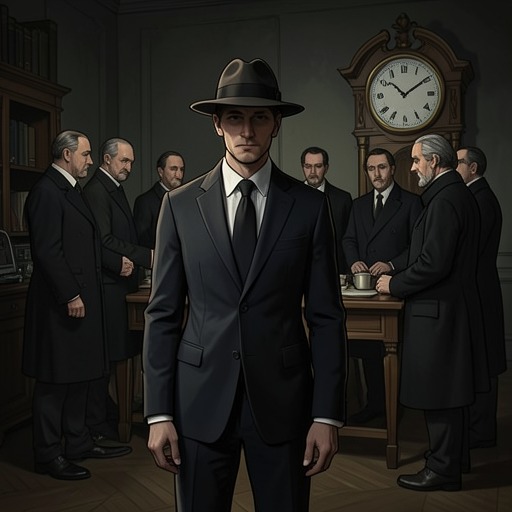
Michael Corleone is physically distinct from the rest of the family. Unlike the other children, with their heavy, curly-haired, Cupid-shaped faces, he has straight black hair, olive-brown skin, and a delicate handsomeness. More important is his chosen alienation. At the wedding, he does not stand with Don Vito Corleone and his brothers but sits in the most secluded corner of the garden, beside Kay Adams, after introducing her to the family. The gesture is not mere shyness. It is a visible declaration that he intends to possess a life whose standards and loyalties are not those of his father.
The family nevertheless recognizes that Michael had once been Don Vito Corleone's favorite and had plainly seemed destined to inherit the business. He possesses the Don's quiet strength and intelligence, along with the instinct to act so that other men have no practical choice but to respect him. The contrast between Michael's self-description and the family's assessment creates the central tension of his character: he believes he has escaped the family system, while the family sees in him the very aptitude required to rule it.
War and the Return to Family Conflict
When World War II begins, Michael volunteers for the United States Marine Corps, directly defying his father's command. Don Vito Corleone tries to prevent the enlistment through bribed doctors, secret arrangements, and considerable expenditure, but Michael is twenty-one and refuses to be controlled. He fights across the Pacific, becomes a captain, and wins medals. In 1944, his military achievements are presented in Life magazine. The Don responds with disdain, saying, "He performs those miracles for strangers." The remark reveals both paternal resentment and the limits of the Don's authority: Michael's courage has been spent in the service of a national power rather than the family.
After receiving an early discharge in 1945 to recover from a disabling wound, Michael spends only a few weeks at home before entering Dartmouth College in Hanover, New Hampshire without consulting anyone. He returns for Constanzia Corleone's wedding with Kay Adams, apparently bringing the future he has chosen into the center of the family he has rejected. That fragile separation collapses when he learns that his father has been shot. In a hotel lobby, Kay finds him staring at a newspaper photograph of Don Vito Corleone lying in the street with Fredo Corleone weeping nearby. Michael feels no immediate grief or fear, only cold rage; then, reading that his father is critically wounded, he is overcome by weakness and guilt because he had been enjoying dinner, the theater, and intimacy with Kay while the attack took place.
The attack turns private feeling into political responsibility. At a family meeting, Michael proposes killing Virgil Sollozzo and Captain Mark McCluskey. He does not merely demand revenge. He devises a public restaurant meeting, insists that the location be made to seem safe, and plans for a weapon to be placed where Sollozzo and McCluskey will not expect it. He also proposes planting evidence that McCluskey is a corrupt police official involved in racketeering, so the murders can be interpreted as the punishment of a criminal rather than an assault on law enforcement. The plan shows Michael's defining method: violence is joined to narrative control, logistics, and the manipulation of public legitimacy.
Exile, Injury, and Reclaimed Sonship
Michael's transformation carries him away from the American family world he had intended to inhabit. After the killings, he is forced into exile in Sicily. There he is wounded, becomes a widower, and remains separated from the family while arrangements are made for his return. His demand that Fabrizzio be found shows that his memory of the attack has not dissolved into distance; the unresolved betrayer remains a fixed point in his political and emotional thinking.
Yet exile also produces a change in his relation to Don Vito Corleone. Michael asks Don Tommasino to tell his father, "Tell my father to get me home," and then adds, "Tell my father I wish to be his son." The request is more than a practical appeal for safe passage. It reverses the earlier posture of chosen alienation. Michael does not ask merely to be protected as an independent man; he asks to be restored to filial belonging. His return to the family is thus presented as both a surrender and a claim: he accepts the father's world while positioning himself to become its future master.
Succession and the Organization of Power
Michael's accession takes place amid institutional strain rather than secure hereditary continuity. When Don Vito Corleone announces his semiretirement and Michael's takeover, the meeting includes Tom Hagen, Carlo Rizzi, Peter Clemenza, and Salvatore Tessio. The atmosphere is tense because succession is not automatically hereditary within the family system. Powerful caporegimes such as Clemenza and Tessio might, under other circumstances, have become Dons or separated to form independent families. Michael therefore inherits authority only within a contested structure whose members must be managed, persuaded, or contained.
The older organization had been built by Don Vito Corleone through layers of insulation. Peter Clemenza and Salvatore Tessio served as caporegimes, Genco Abbandando as Consigliere, and operational orders moved through buffers so that the Don could remain distant from specific acts. Tom Hagen's appointment as Consigliere had already broken the tradition that the office belonged to a full-blooded Sicilian, replacing blood-based custom with demonstrated loyalty and administrative usefulness. Michael inherits this system of concealed command, but he also inherits its danger: authority depends on distance, disciplined information, and the possibility that a compromised link can be removed.
Don Vito Corleone's power had grown by answering needs that law and government failed to meet. During the Great Depression, he helped people obtain relief, employment, loans, freedom from jail, and protection from landlords. He cultivated political influence by supporting poor Italian boys through college until they became lawyers, assistant district attorneys, and judges. By 1939, he had carried a peace agreement among major underworld organizations in Los Angeles, San Francisco, Cleveland, Chicago, Philadelphia, Miami, and Boston. The arrangement preserved each group's internal authority while enforcing peace and defining spheres of influence. Michael inherits not only a criminal enterprise but an alternative system of protection, credit, political access, and coercion.
The cost of his succession is visible in the family's decline after Don Vito Corleone makes peace with the Five Families. The Barzini Family becomes the dominant power in New York City, allied with the Tattaglia Family, and begins taking over Corleone gambling territory. Michael must therefore rule a family whose old personal prestige has weakened and whose rivals are testing every sign of hesitation. His authority is built through the response to that weakness: patient maneuvering, controlled retaliation, and the reassembly of power under a single center.
Final Authority and Moral Transformation
By the end of the narrative, Michael has become the most powerful Family chief in the United States after a year of delicate political maneuvering. He divides his time between the Long Beach mall and a new home in Las Vegas, then decides to close the New York operation and sell the houses and mall property. The move is both geographical and historical. The old headquarters, with its dense local relationships, is being exchanged for a western base associated with expansion and control. The Corleone Family is now unchallengeable; Clemenza has his own Family, Rocco Lampone serves as Michael's caporegime, Albert Neri heads security for the family-controlled hotels in Nevada, and Tom Hagen belongs to Michael's Western Family.
Michael's final power is inseparable from his ability to make falsehood appear trustworthy. When Kay Adams asks whether the accusations against him are true, he denies them while deliberately using the mutual trust of their married life to persuade her. She accepts the denial and embraces him. Immediately afterward, Peter Clemenza enters with Albert Neri and Rocco Lampone and formally addresses Michael as "Don Michael." The juxtaposition exposes the new order: Kay is granted a reassuring domestic explanation, while the family recognizes the criminal sovereign behind it. Michael's mastery is therefore not only command over men and territory but command over competing versions of reality.
Michael's reconciliation with Constanzia Corleone follows the consolidation of his authority. After her accusations, she apologizes and assures Kay that her words were untrue, the product of a young widow's hysteria. The family closes ranks around Michael even as his domestic life rests on concealment. His transformation from the estranged college student and decorated Marine into Don Michael completes the book's most consequential reversal: the son who once sought freedom from Don Vito Corleone's system becomes the figure who perfects its organization, extends its reach, and makes its violence compatible with an appearance of legitimacy.